Transcriptional Response to Chronic Long-Access Fentanyl Self-Administration in Rat Habenula and Amygdala
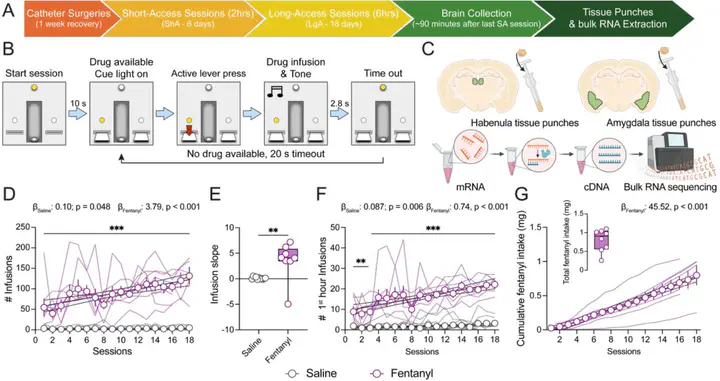 Image credit: bioRxiv
Abstract
Fentanyl is a potent synthetic opioid associated with overdose. However, little is known about fentanyl-induced molecular adaptations in the habenula and amygdala, two brain regions implicated in opioid use and withdrawal. We performed bulk RNA-sequencing in the rat habenula and amygdala to identify transcriptomic changes associated with fentanyl intake. Male rats self-administered intravenous saline or fentanyl over 22–24 days. Ninety minutes following the final session, brains were collected for transcriptomic profiling. In Hb, we identified 453 differentially expressed genes (DEGs) between saline and fentanyl rats, with upregulated genes associated with synaptic transmission and ionic conductance. In the amygdala, we identified 3041 fentanyl-associated DEGs with upregulated genes implicated in metabolic and vesicular functions. Downregulated genes in both regions were enriched for extracellular matrix functions. Integration of DEGs with single-cell RNA-sequencing data from rodents and humans revealed that fentanyl DEGs were enriched in specific habenula and amygdala cell type markers. Furthermore, fentanyl downregulated DEGs in the amygdala were enriched in genes associated with the risk for substance use disorders. Together, we define how fentanyl intake alters transcriptional programs in the rat habenula and amygdala, and we link these changes to specific human cell types and risk genes for neuropsychiatric disorders and addiction.
🧠🧬 What are the effects of intravenous fentanyl self-administration on the habenula and amygdala transcriptomes?
In our new Addiction Biology paper, we addressed this question using a chronic long-access model in rats! Here are some highlights 🧵👇
Paper 👉 dx.doi.org/10.1111/adb….
— Robin Magnard (@robinmagnard.bsky.social) July 30, 2026 at 10:48 AM
[image or embed]

Daianna Gonzalez-Padilla
LIBD Summer Intern 2022, Intern 2022-ongoing

Nicholas J. Eagles
Research Assistant 2018-2021, Research Associate I 2021-2024, Research Associate II 2024-ongoing

Leonardo Collado-Torres
Investigator @ LIBD, Assistant Professor, Department of Biostatistics @ JHBSPH
#rstats @Bioconductor/🧠 genomics @LieberInstitute/@lcgunam @jhubiostat @jtleek @andrewejaffe alumni/@LIBDrstats @CDSBMexico co-founder