 Image credit: bioRxiv
Abstract
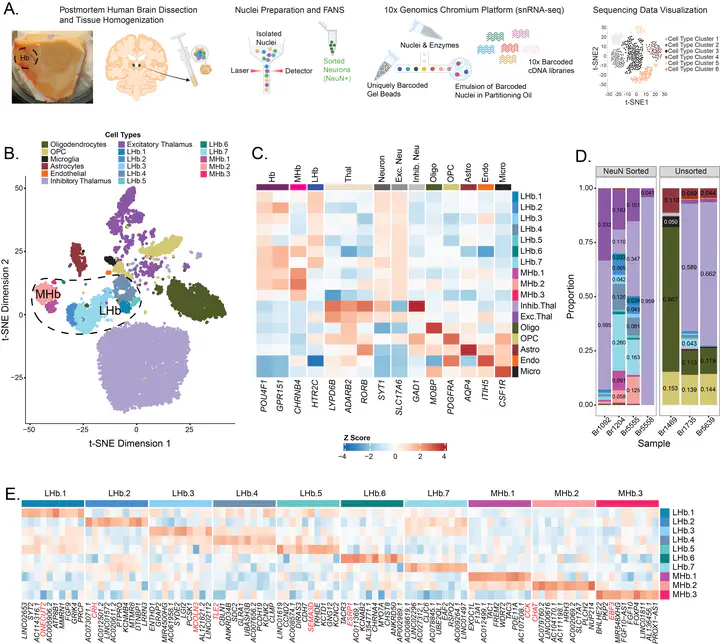
Objective: The objective of this study was to define the molecular neuroanatomy of the human habenula (Hb) and identify transcriptomic differences between brains of individuals with schizophrenia and nonpsychiatric control brains. Methods: This study utilized Hb-enriched postmortem human brain tissue. Single-nucleus RNA sequencing (snRNA-seq) was conducted to identify molecularly defined Hb cell types (N=7 donors), and single-molecule fluorescent in situ hybridization (smFISH) was performed to validate cell types and map their spatial locations (N=5 independent donors). Bulk RNA sequencing (RNA-seq) (schizophrenia, N=35; nonpsychiatric control, N=33) and cell type deconvolution were used to identify differentially expressed genes (DEGs), which were then compared to dorsolateral prefrontal cortex, hippocampus, and caudate schizophrenia DEGs. Expression quantitative trait loci (eQTLs) and schizophrenia risk colocalization analyses were performed. Results: snRNA-seq identified 17 cell type clusters across 16,437 nuclei, including three medial and seven lateral Hb populations, several of which were conserved in rodents. smFISH validated snRNA-seq Hb cell types and depicted their spatial organization. Bulk RNA-seq analyses yielded 173 schizophrenia-associated DEGs (false discovery rate<0.1), of which 129 (75%) were unique to Hb-enriched tissue. eQTL analysis identified 717 independent single-nucleotide polymorphism (SNP)-gene pairs (false discovery rate<0.05). Of these, 16 pairs included a SNP that is a schizophrenia risk variant, and seven different pairs included a schizophrenia DEG. eQTL and schizophrenia risk colocalization analysis identified 16 colocalized genes, nine of which have not been previously identified. Conclusions: These results identify topographically organized cell types with distinct molecular signatures in the human habenula and demonstrate unique genetic differences associated with schizophrenia, thereby providing novel molecular insights into the role of the habenula in neuropsychiatric disorders.
I’m excited to share our first human habenula study comparing transcriptomic data from neurotypical control postmortem tissue and schizophrenia cases! 🧠 #HabenulaLIBD #snRNAseq #Habenula
— Louise Huuki-Myers (@lahuuki) March 7, 2024
This is my first paper as co-corresponding author!
📎 https://t.co/tePWIaSQXB pic.twitter.com/M2CTDRKz3O
It's great to see #HabenulaLIBD on @biorxivpreprint and be publicly accessible to you. It's a major milestone (peer review is next 🤞🏽)
— 🇲🇽 Leonardo Collado-Torres (@lcolladotor) March 7, 2024
It also feels like the end of a large cycle. At the same time, it's the start of Hb 🧠work we are pursuing with @kr_maynard @LieberInstitute 🔬 pic.twitter.com/UbFpYwdRtx

Renee Garcia-Flores
Contractor 2023 Feb-Aug

Nicholas J. Eagles
Research Assistant 2018-2021, Research Associate I 2021-2024, Research Associate II 2024-ongoing

Joshua M. Stolz
Research Associate 2018-2022

Louise A. Huuki-Myers
Research Associate 2020-2022, Staff Scientist I, Data Science 2022-ongoing, PhD Student 2024-ongoing

Leonardo Collado-Torres
Investigator @ LIBD, Assistant Professor, Department of Biostatistics @ JHBSPH
#rstats @Bioconductor/🧠 genomics @LieberInstitute/@lcgunam @jhubiostat @jtleek @andrewejaffe alumni/@LIBDrstats @CDSBMexico co-founder